
What is a rainwater harvesting system?
A rainwater harvesting system collects rainwater from your roof, filters it, and stores it in an underground tank, so it can be used for toilet flushing, laundry, and garden instead of clean drinking water.

Turn rainwater into a resource
A typical detached house receives large quantities of rainwater on its roof every year. Instead of letting the water run directly into the sewer, it can be collected and used for purposes where drinking water quality is not necessary.
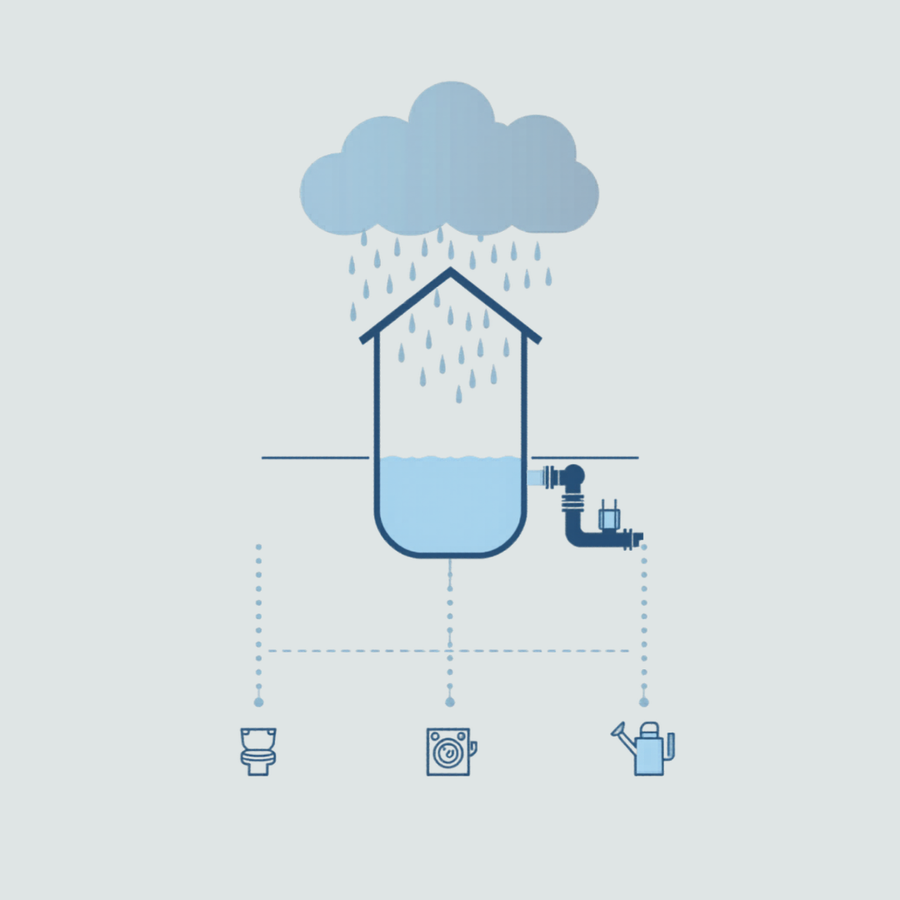
With a rainwater harvesting system, water is guided from the gutters through a filter and into a tank. From there, it is automatically pumped into the home and can be used for toilet flushing, laundry, and garden watering.
This way, you reduce your consumption of drinking water and get more value out of a resource that already falls on your roof. When the tank is empty, the system automatically switches to regular drinking water, so you won't notice any difference in your daily life.
From rain on the roof to water in the home
A complete system that collects, filters, and stores rainwater so it can be automatically reused in the home and garden.
Summary
Rainwater is collected from the roof via downpipes.
Filtering
Coarse filter and fine filter remove leaves and particles.
Storage
The water is stored in an underground tank.
Application
Used for toilets, washing machine and garden.
A complete system — delivered turnkey
Tank, filter, pump and intelligent control system. All designed to work together and deliver clean rainwater to your home — without you having to think about it.
- Tank
- 3,000–10,000 litres buried
- Filter
- Self-cleaning 3-stage filtration
- Pump
- Quiet, energy-efficient operation
- Governance
- App monitoring and automation
Why install a rainwater harvesting system?
Lower water bill
Up to 50% of a household's water consumption can be covered by rainwater — you pay neither water charges nor sewage fees for it.
Save up to 40% CO2
The rainwater is collected in a tank right next to the house. It requires far less energy to pump up than drinking water, which has to be extracted from groundwater, purified at the waterworks, and sent through the pipe network.
Relief of the sewer
The tank buffers rainwater during cloudbursts and reduces the risk of overload and flooding.
VA-approved and legal
The facilities meet Danish standards with physical separation from the drinking water installation.
That's what people ask us most often
What can I use rainwater for in my home?
Rainwater can be used for flushing toilets, laundry, and garden irrigation. These are some of the largest water consumers in a household, and they do not require drinking water quality. Together, this can replace up to half of your water consumption.
Is it safe to wash clothes in rainwater?
Yes. Rainwater is soft water with almost no lime, which is actually an advantage for both the washing machine and the clothes. You use less detergent, and the machine is less burdened by limescale deposits. The system filters the water before it reaches the washing machine.
What happens when it hasn't rained for a long time?
The system automatically switches to regular drinking water, so you are never without water. The switch occurs via an approved backflow prevention device, and you won't notice it in your daily life.
Does it require a lot of maintenance?
No. You check the filter a couple of times a year and the tank is inspected once a year. This takes a few minutes and is comparable to the maintenance you already do on your home.
What is a VA approval — and why is is important?
A VA approval is an official Danish system approval issued by ETA-Danmark. It documents that the entire system – filter, tank, pump, and control – has been tested and approved as a complete solution. This gives you assurance that the system complies with building regulations and undergoes continuous quality control.
How big should the tank be?
The size depends on the roof area, household consumption, and local rainfall. Typical detached houses use a tank of 3,000-6,000 litres. Our calculator provides a concrete estimate.
Can it be installed in an existing home?
Yes. It requires a buried tank in the garden and an extra water circuit for the toilet and washing machine. If you are building new, it is both cheaper and simpler to include from the start.