
When you first hear about reusing rainwater in your home, it's natural to ask: is it really safe? This is an important question and deserves a thorough answer. In short: yes, it is safe – when the system is correctly installed and complies with current regulations. Here's why.
What do the laws say?
In Denmark, the reuse of rainwater in private homes is regulated by the building regulations and Pipe Centre Guideline 003. The rules are clear and set requirements for both installation and operation:
Separate piping system. Rainwater and drinking water must be carried in completely separate pipes that are never directly connected. This means there is no risk of rainwater mixing with your drinking water. All connection points must be clearly marked so that no confusion ever arises.
Approved use. Rainwater may be used for toilet flushing, laundry, and garden watering in private homes. These are the applications where drinking water quality is not necessary, and where rainwater performs at least as well.
Notification to the municipality. Before installing a rainwater system, it must be notified to your municipality. This ensures that the installation meets local requirements and current legislation.
The rules are in place to protect you and your family, and a correctly installed system automatically complies with them.
How is water quality ensured?
Rainwater collected from the roof is not the same as surface water from roads and squares. Roof water is relatively clean already at collection, and with the right filtration, the quality becomes completely suitable for the approved purposes.
Filtration occurs in several stages
First, the water passes through a pre-filter at the downspout, which catches leaves, twigs, and coarser particles. The best filters are self-cleaning; they direct impurities to the sewer, while the clean water is directed to the tank. The tank's design ensures that the water is kept cool and dark underground. This prevents algae growth and bacterial formation.
The inlet is designed so that water is added calmly at the bottom of the tank, thereby avoiding stirring up sediment. The overflow at the top of the tank removes floating particles and ensures constant circulation.
Finally, a fine filter can be added at the pump station, which ensures the final purification before the water is sent to toilets and washing machines.
Water quality for laundry
A question many ask is whether rainwater is good enough to wash clothes in. The answer is yes, and in fact, rainwater has an advantage here. Rainwater is soft water, meaning it is almost free of lime. This means you use less detergent, and your washing machine is less stressed by lime deposits. Many find that clothes feel softer and that the washing machine lasts longer.
The most common concerns - and the answers
"Can bacteria get into the water?" In a correctly dimensioned and installed system, the risk is minimal. The dark, cool tank inhibits bacterial growth, and filtration removes the particles that bacteria typically attach to. Furthermore, rainwater is not used for drinking water, cooking, or bathing; only for purposes where quality requirements are lower.
"What about pollution from the roof?" Most roofing materials; tiles, concrete roof tiles, slate, and roofing felt are suitable for rainwater collection. Roofs with copper or zinc cladding are not recommended, as metals can dissolve in the water. If you live close to a heavily trafficked road, it may be relevant to discuss any particles with your installer.
"What happens if the tank runs dry?" The system has an automatic switch to ordinary drinking water. You won't notice any difference in everyday life; water will always come out of the tap and into the toilet, regardless of whether it's rainwater or drinking water in the tank.
"Does the municipality have to approve it?" You must notify the municipality of the system, but this is a standard procedure. Your installer can typically help with the practical part.
Security through documentation and VA approval
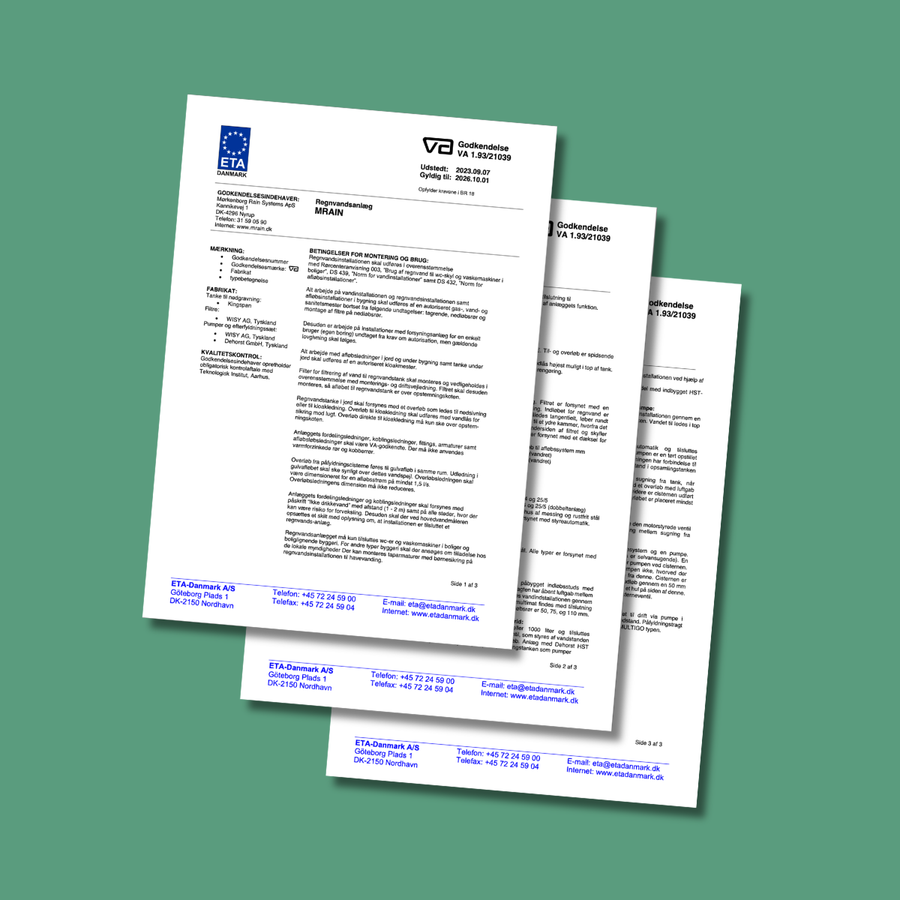
Rainwater systems cannot be CE marked like many other building products. Therefore, the Building Regulations (BR18, §459) require that the systems undergo separate testing and approval. This is where VA approval comes in.
A VA approval is an official Danish system approval issued by ETA-Danmark, which documents that a complete rainwater system – filters, tanks, pumps, and control – meets the requirements of Pipe Centre Guideline 003, DS 439, and DS 432. It is not an approval of a single product, but of the entire system as a complete solution.
What does this mean for you as a homeowner?
When you choose a VA-approved system, you know that all components have been tested and approved to work together. The approval holder maintains a mandatory quality control with the Danish Technological Institute in Aarhus, which continuously ensures that the products meet the specified requirements. This gives you a security that non-approved systems cannot offer.
Specifically, the VA approval means that the system complies with the requirements for separating rainwater and drinking water (in accordance with EN1717), that filtration, tank design, and pump solution have been tested as a system, and that the installation can be carried out in accordance with current building regulations.
Today, MRAIN is the only rainwater system in Denmark with a valid VA approval. It requires significant effort to obtain and maintain the approval. But it is precisely this kind of documentation that makes the difference when you have to make a decision about your home.
It's about doing it properly
The safety of a rainwater system ultimately depends on it being correctly installed and maintained. That's why it's important to choose a VA-approved system from a documented manufacturer and have an authorized installer handle the connection. When done correctly, a rainwater system is a safe, reliable, and low-maintenance part of your home – year after year.
Now you know that rainwater is safe to use. But what does it actually cost to get started? Read our article: "What does a rainwater system cost – and when does it pay for itself?"